
Home |
Up |
Prev |
Next |
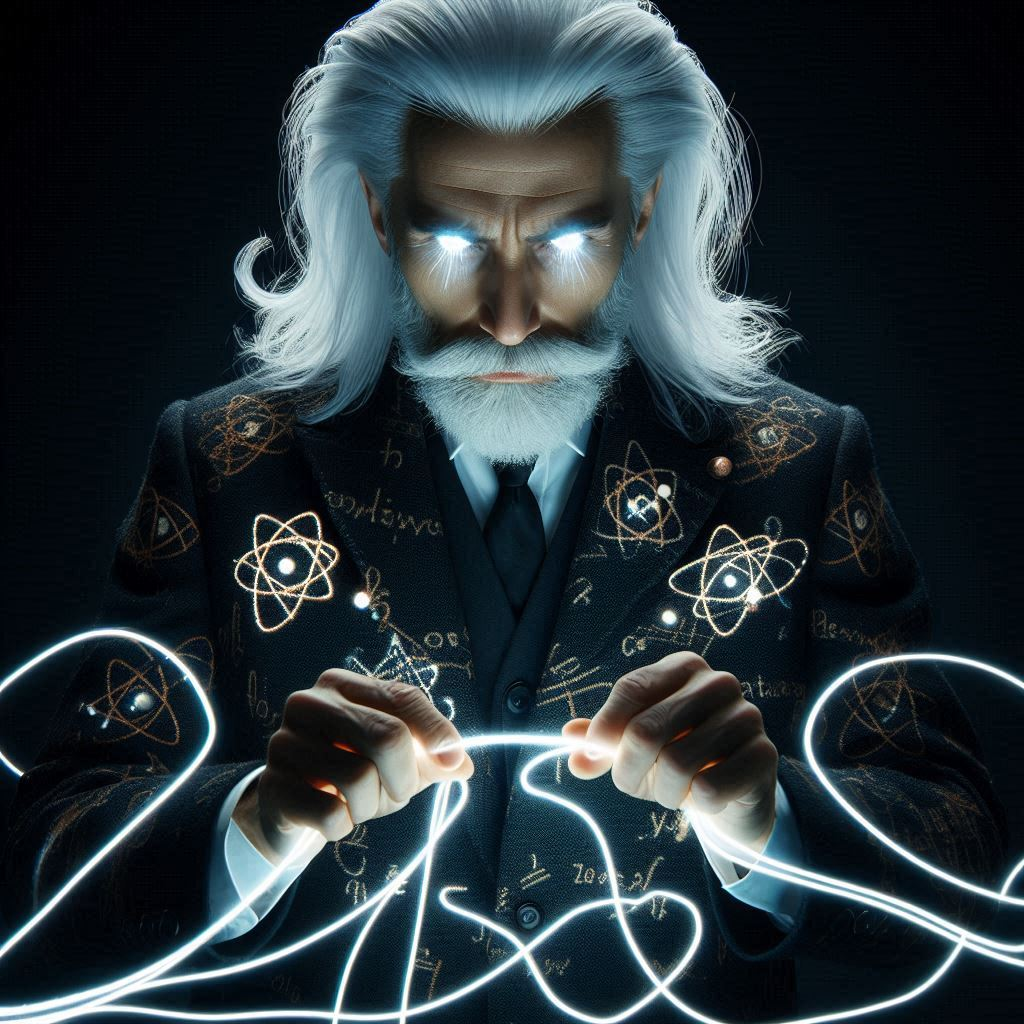
The physicist's god examining the strand of physical constraints embodying the laws of the universe.
The Old 100th
"The Old 100th" is one of the strongest and best known hymns in the Anglican canon. It is based on the 100th Psalm from the Christian Bible. It tells the people that God is good and that he made us and not we him, that we are his sheep and we should be thankful, joyful and praise him with song.
The tune for this popular hymn was written by Loys (Louis) Bourgeois in 1551 and published in the Genevan Psalter of that year. He originally wrote the tune for Psalm 134 but it was later adopted for the 100th. The best loved version of the words was written by William Kethe in 1561 while he was in Geneva translating the Geneva Bible into English.
Supposedly Bourgeois produced 4 part harmonisations of the hymns in his Psalter notwithstanding that the published version was only the melody. Wikipedia shows an SATB version of the hymn supposedly by him but I am skeptical, as it is almost identical to the modern versions. I would need to see the original manuscript to be convinced. Bourgeois' melody was also harmonised to SATB by Claude Goudimel in 1564 along with the rest of the Genevan Psalter. Some, (approaching half), of his harmonic basis of the hymn is still there in the versions in common use today. As to who wrote the greater half I was unable ascertain. Certainly it may be found in "Songs of Praise" in 1925 which was edited by Ralph Vaughan-Williams but if RVW had a hand in this harmonisation he didn't give himself credit in the book.
Numerous composers have composed works based on this hymn tune including Blow or Purcell, Bach, Parry, Dowland, Britten and Mendelssohn. In 1953 Ralph Vaughan-Williams wrote THE great arrangement of the hymn for the coronation of Elizabeth II, scored for organ, choir, congregation, orchestra and brass with trumpet flourishes. It is a masterpiece that endures to this day and the inspiration for my rewrite. In perhaps his finest effort, RVW puts together 5 unique, beautifully contrasting sections for each of the 5 verses: trumpet fanfare, singers in unison with full backing, unison congregation with choir in harmony and backing, acapella choir with trumpet descant, Dowland's faburden by choir and orchestra, grand tutti finale with all singers in unison. The effect is deep and immense and once heard you will never forget it. Like John Dowland, I thought I would have a go at writing a counter-melody to this famous tune, which I then used in my rewrite of RVW's masterpiece in place of Dowland's. This is not to disparage Dowland's quality effort; I just wanted to have a go. I think both counter-melodies are good and either could be used for verse 4.
The Laws Of The Universe
I woke up one morning with the idea to write new words to this famous old hymn. I listened to it again and was impressed by the grandeur of RVW's setting. The hymn sounded like the Church laying down the law: "This is the way it is. Don't argue. Be grateful and do as you are told!" I wondered what law a church of atheist scientists would lay down and it was obvious: "The Laws Of Universe."
But what are the laws of the universe, who discovered them and if they keep changing, how can we place our faith in them?
Physics is the science devoted to the elucidation of the laws of the universe and it has many great geniuses in its domain but they need maths in order to express these laws and maths needs logic in order to operate and so it is that the laws of the universe require not only an understanding of Physics but also of Maths and Logic.
The foundations of the Universe might appear straight-forward on the surface but the deeper you dive into it the stranger it gets and the less you really understand. For example: We don't really understand what mass is. We don't have any idea of the structure of matter inside a black hole singularity. The random nature of real world QCD is too chaotic to get a handle on. We don't fully understand light. We don't have a proper explanation for galactic dynamics and space-time expansion etc...
The Church of Infinite Dimensions teaches that since there are infinite dimensions we will NEVER achieve a full understanding of the true basis of the Universe. The laws that we uncover are merely small pieces of an infinite jigsaw puzzle. Nevertheless, these pieces are still of GREAT value! They have built all our modern technology and made us super-human! We should celebrate the progress that we have made and the people that have found the pieces that we do have. We should not let the impossibility of solving the entire edifice hinder us in our search for more pieces.
In the pre-scientific era we thought that matter was composed of earth, water, air and fire. With the advent of the scientific method we thought it was made of atoms of thousands of different types. Then we found it was made of molecules which were, in turn, composed of atoms of just 100 elements. Then we thought that atoms were composed of a tiny nucleus of protons and neutrons with tiny electrons whizzing around in orbit. Then we thought that electrons were actually resonant "clouds" filling "orbitals" in "shells". Then we thought that protons and neutrons were themselves composed of quarks of varying "colours" held together by gluons. etc...
This pattern is reproduced across the entire field of physics; where research, analysis and inspiration lead to the development of our understanding and production of new theories. Science critics point to this evolution as a sign that Science cannot be trusted, since today's law will be superceded by tomorrow's. Their reasoning is fallacious. Scientific theories that were proved correct at the time are still valid to this day WITHIN THEIR SCOPE. For example: Chemistry that is built on the theory of molecules and elements will still work perfectly well despite the fact that physics has moved on to sub-sub-atomic particles. Newton's kinematics will still work perfectly well, so long as you keep your all speeds well below that of light and your resolution of space and time well below that of the space age and avoid stellar and galactic concentrations of mass. So long as you keep the scope of your investigation close to that available at the time the law was formulated, any properly formulated and scientifically tested law will remain true everywhere and for all time. At least that is the supposition under which we scientists operate and it is yet to be proved wrong.
Science is far better than religion. You don't need "faith" to use Science! You can test Science; anytime, anywhere. It has NEVER been found to be wrong within the original scope of the theory under investigation. Get behind it people and drop religion from your lives. Unlike religion: you can understand it, (to an extent), you can make it work for you, and it will never let you down.
Viva la Scienza!
Melody: "The Old 100th", Loys Bourgeois 1551
Counter Melody: Warren Mars 2026
Words: Warren Mars, 2026
Harmony: Claude Goudimel, 1564 et al
Grand arrangement: Ralph Vaughan-Williams (adjusted by Warren Mars)
All people that on earth do dwell:
The universe is built on laws,
That form and arbitrate all things,
Immutable through space and time.
The heart of all is resonant waves,
Of EM, nuclear and mass,
All are bosons and fermions,
Essential things must be conserved.
Pythagoras, Al-Khwarizmi,
Gauss, Newton, Euler, Heisenberg,
Planck, Frege, Gell-Mann, Schrödinger,
Euclid, Maxwell, Dirac, Einstein.
The world we see is just a glimpse,
Of infinite totality.
Regardless of how deep we go,
There always will be more to find.
These are the Universal Laws,
Go test them to your heart's desire,
Forever true within their scope,
Unshakeable until the end.
The vocal score with chords is provided here.
I have also provided an SATB arrangement for choirs here.
Finally I have provided my adjusted version of Vaughan-Williams' grand arrangement with trumpets, organ and additional basses here.
As usual I have provided a recording of my computer synthesizer playing the standard SATB arrangement.
Go ahead and sing along!
But that is not all! Here is my rewrite of Vaughan-Williams' grand arrangement. There is no singing and the synthesizer is very ordinary but go ahead and check it out.
For those that may be interested in the artistic and analytic process I videoed myself developing this hymn and uploaded the results to YouTube. It is in 3 parts:
1 - About the "Old 100th" and Ralph Vaughan-Williams.
2 - Writing the new words and talking about the foundations of Physics.
This is very long at 2 hours but it shows me writing lyrics about the basis of the Universe in real time, complete with brain-storming, research, drafting and rethinking. It's only interesting if you want to see how I work.
* Note that lyrics are not the same as normal poetry and should not be judged as such: They are meant to be SUNG, not read aloud. Criticise them AFTER you have sung them, not before.
3 - Looking at the existing music and adjusting RVW's great coronation arrangement.
This has been quite a journey! I hope that my rewrite will be found to be good work and that people will sing this hymn after I'm gone.
Excelsior!
Warren Mars - March 2026